Strength and Structure Built to Last
Concrete in Fort Worth for driveways, foundations, and flatwork that withstand Texas heat and soil movement
RMC Concrete & Construction LLC provides full-service concrete installation across Fort Worth and throughout Texas, handling residential and commercial projects that require durable, long-lasting results. You need concrete that can hold up under vehicle weight, resist cracking from soil expansion, and cure properly in extreme heat. Whether you're pouring a foundation for a new build, replacing a deteriorated driveway, or adding outdoor flatwork, the installation process begins with proper grading, reinforcement layout, and attention to drainage patterns that prevent water from pooling near structures.
The work involves site preparation, forming to exact dimensions, pouring mixed concrete at the correct consistency, and finishing the surface to the specified texture. In Texas, high temperatures accelerate curing, which means timing the pour and applying curing compounds or coverings to prevent surface cracking. Structural pours require rebar placement and inspection before concrete is introduced, while flatwork focuses on slope, thickness, and joint placement to manage natural expansion and contraction. Each project is planned around soil conditions, load requirements, and long-term performance rather than appearance alone.
If you're planning a concrete project in Fort Worth or elsewhere in Texas, RMC Concrete & Construction LLC offers clear estimates and defined timelines based on the scope and site conditions.
What Happens During a Concrete Installation
Your project starts with excavation or base preparation, followed by compacting the subgrade to create a stable surface that won't shift under the weight of the concrete. Forms are built to outline the pour area, and any required reinforcement such as rebar or wire mesh is positioned and tied off. The concrete is mixed to the right slump for the application, poured in sections if needed, and leveled using screeds and floats. Finishing tools create the final texture, whether that's a smooth trowel finish, a broom finish for traction, or a decorative stamp.
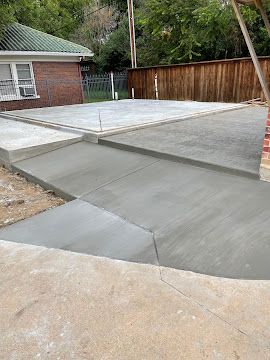
Once the pour is complete, you'll see a clean, level surface with defined edges and proper slope for water runoff. RMC Concrete & Construction LLC ensures that joints are cut at the right intervals to control where cracks appear, and that curing methods are applied to strengthen the slab as it hardens. The result is a solid, functional surface that supports its intended load without sinking, cracking prematurely, or holding water.
The timeline depends on the size of the pour and site access, but most residential flatwork can be formed, poured, and finished within a few days. Structural work such as foundations may involve inspections and longer curing periods before framing or additional construction begins. Decorative finishes, thicker pours, and projects requiring extensive grading will extend the schedule, and weather conditions can affect when it's safe to proceed.
What to Know Before You Start
Concrete work in Texas often raises questions about timing, durability, and what to expect during and after the pour. Here's what comes up most often when planning a project in Fort Worth or across the state.
What thickness is required for a residential driveway?
Most residential driveways are poured at four inches thick with wire mesh or rebar reinforcement, but if you're parking heavy vehicles or trucks regularly, six inches provides better load distribution and reduces the risk of cracking under weight.
How long before you can drive on new concrete?
You should wait at least seven days before driving on a newly poured driveway, and longer in cooler weather when curing slows down, since concrete reaches most of its strength in the first week but continues hardening for weeks after that.
Why does concrete crack even when it's new?
Concrete naturally shrinks as it cures, and control joints are cut into the surface to direct those cracks into planned locations rather than letting them appear randomly across the slab.
What's involved in preparing the ground before a pour?
The subgrade is excavated to the correct depth, compacted to prevent settling, and leveled so the finished concrete sits at the right height relative to surrounding surfaces and drainage paths.
How does Texas soil affect concrete work?
Expansive clay soils common in Fort Worth shift with moisture changes, so proper base preparation and reinforcement help the slab move as a unit rather than cracking in sections when the ground swells or contracts.
RMC Concrete & Construction LLC works with residential and commercial clients throughout Texas, providing concrete installations built for strength, drainage, and long-term performance. If you're ready to move forward with a concrete project in Fort Worth, reach out to discuss site conditions, project scope, and scheduling.