Solid Ground for New Construction
Foundations in Fort Worth for new homes, additions, and slab-on-grade construction that resist soil movement and settling
RMC Concrete & Construction LLC installs concrete foundations for new homes, additions, and pad foundations across Fort Worth and throughout Texas, working with builders, contractors, and property owners who need precision grading, code-compliant forming, and structural integrity that lasts. You're dealing with expansive clay soils that shift with moisture, extreme heat that affects curing, and the need for a foundation that won't crack or settle unevenly under load. The process begins with site evaluation, excavation to the correct depth, and layout that matches architectural plans and local building codes.
Foundation work involves grading the site to ensure proper drainage away from the slab, compacting the subgrade to prevent voids, and building forms that define the edges and elevation of the pour. Rebar is placed according to engineering specifications, inspected, and tied off before concrete is introduced. The pour itself is timed to avoid the hottest part of the day when possible, and the surface is leveled and finished to create a flat, stable platform for framing. In Texas, soil movement is a constant factor, so the design includes reinforcement and joint placement that allow the slab to move as a single unit rather than cracking in sections.
If you're planning a new build or addition in Fort Worth, RMC Concrete & Construction LLC provides foundation services that meet structural requirements and account for local soil behavior.
How a Foundation Pour Comes Together
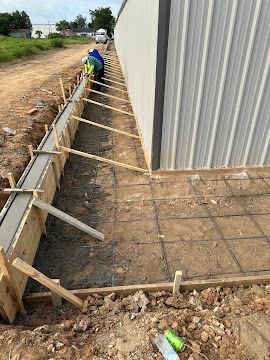
Your foundation starts with excavation and rough grading, followed by compaction of the subgrade using mechanical tampers or rollers to eliminate soft spots. Forms are built to the exact dimensions shown on the plans, with stakes and bracing to hold them in place during the pour. Rebar is laid out in a grid pattern, elevated off the ground using chairs so it sits in the middle of the slab thickness, and inspected by the local building authority before concrete is scheduled. The concrete is delivered by truck, poured in sections, and spread using rakes and shovels before being leveled with a screed.
After the pour, you'll see a flat, solid slab with clean edges, embedded anchor bolts for framing, and a surface ready for construction. RMC Concrete & Construction LLC ensures that the foundation is cured properly using water, curing blankets, or chemical compounds, and that it meets the thickness, reinforcement, and elevation requirements outlined in the building permit. The slab will support the structure without shifting, cracking along stress points, or allowing water to collect near the perimeter.
The timeline depends on site conditions, slab size, and inspection schedules, but most residential foundations are ready for framing within a week of the pour. Larger pads or commercial foundations may require multiple pours, additional reinforcement, and longer curing times. Weather delays are common during rainy periods, and inspections must be completed before the pour can proceed.
What You Should Know About Foundation Work
Foundation projects in Fort Worth and across Texas often involve questions about soil preparation, timing, and what happens after the concrete is poured. Here's what homeowners and builders ask most often.
What makes a foundation fail in Texas?
Most failures come from poor soil compaction, inadequate drainage that lets water accumulate under the slab, or missing reinforcement that allows the concrete to crack when the ground shifts during wet and dry cycles.
How thick should a residential slab foundation be?
Standard residential slabs are four inches thick at the center with thickened edges that extend deeper into the ground, but the exact design depends on soil reports and engineering requirements for the structure being built.
How long does a foundation need to cure before framing starts?
You can typically begin framing after seven days, but full strength develops over 28 days, so heavy loads and permanent attachments should wait until the slab has fully hardened.
What's involved in a pre-pour inspection?
The inspector checks that forms are level and properly braced, that rebar is placed and tied according to the plan, and that the subgrade is compacted and free of debris or standing water before approving the pour.
Why is grading so important for a foundation?
Proper grading directs water away from the slab, preventing erosion under the edges and reducing hydrostatic pressure that can cause cracking or heaving when the soil expands.
RMC Concrete & Construction LLC works with residential and commercial clients throughout Texas, providing foundation installations built for durability, code compliance, and long-term structural performance. If you're ready to schedule a foundation pour in Fort Worth, contact the team to review your project plans and site conditions.